blog / Sales recovery automation: the p...
Sales recovery automation: the profit lost in silence, not in ad spend
The money isn't lost in the ad, it's lost in the silence
Anyone selling on WhatsApp knows the pattern. For every group of people who reach checkout, a share of them stalls right there: they fill in their details and never finish, they generate an invoice or a Pix payment and never pay, their card gets declined and they never try again, or a subscription fails to renew without anyone noticing.
In all of these cases the lead has already been through the expensive part of the funnel. They saw the ad, clicked, read the offer, decided to buy. They stopped at the cheapest stage to fix and, at the same time, the easiest one to let slip, because it requires monitoring an event in real time and responding in minutes, not days.
That's profit already paid for in ad spend, sitting halfway down the road. Sales recovery automation closes that gap on its own, without depending on someone remembering to send the second message at the right time or opening a spreadsheet to check who already paid. At Claryflow, automation flows do that work.
Sales recovery automation: how it works in practice
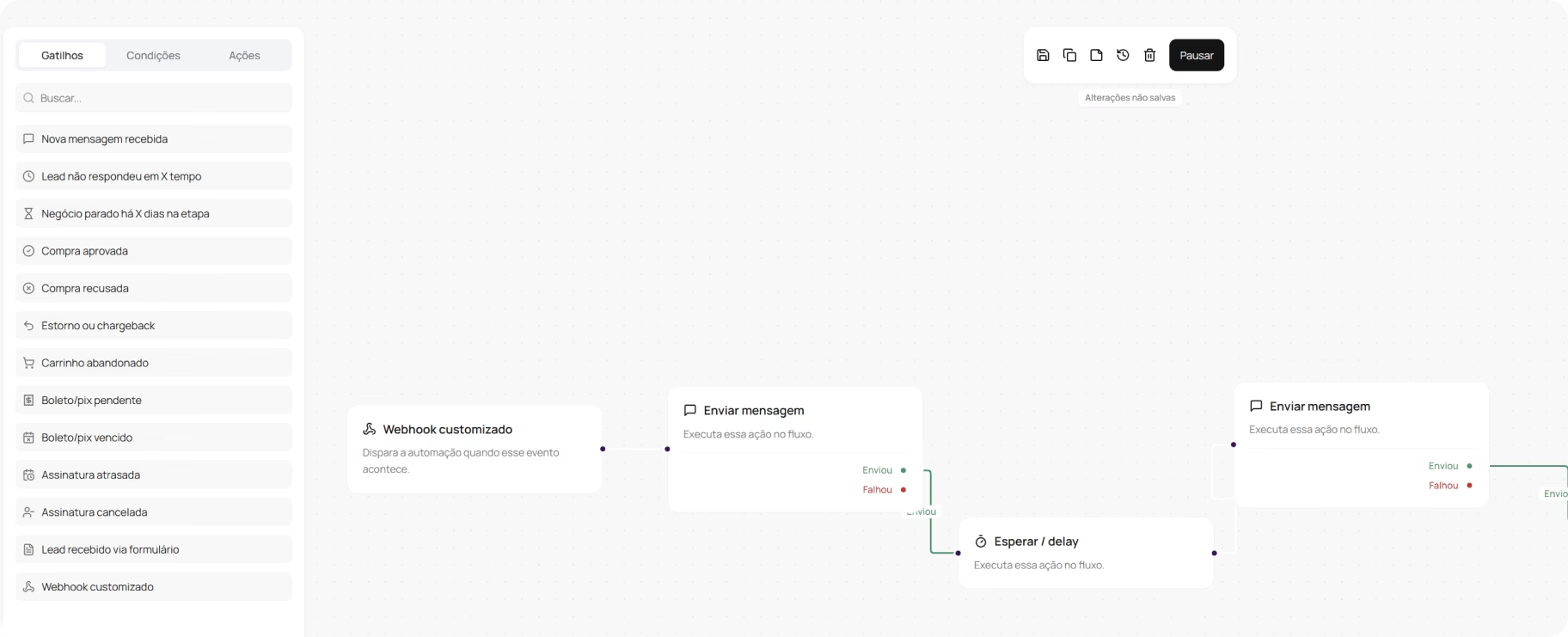
A flow is built on a visual canvas, connecting three kinds of block: a trigger, which starts it (abandoned cart, pending invoice, declined card, overdue subscription), a condition, which branches the path with a yes-or-no question, and an action, which does something (send a message, wait, move the card in the funnel, end the flow). The design stays visible on screen, with the "yes" and "no" paths clearly laid out, and it runs on its own when the event arrives. No technical knowledge required.
The difference from the simplified automations already available in Claryflow is structural. A simplified automation is a linear sequence per event: event X fires message Y and that's the end of it. A flow is branched: you can wait, ask, decide and change course midway, which changes everything when the goal is recovering a sale across several days.
This connects directly to how you already organize the funnel in your pipeline and lead management: the flow is what fires the right action inside the stages you already see there.
Read also: CRM and lead management, why your operation loses sales without it
Complete, but designed for you to build it yourself, with no setup fee
Flow-builder tools with a complete catalog usually come packaged with a long learning curve: paid training, a dedicated consultant to design the first sequence, weeks before the customer can edit a flow on their own. That implementation cost normally sits outside the subscription and only shows up later.
Claryflow's catalog of triggers, conditions and actions was built the other way around, deliberately lean. There are 13 triggers, 3 conditions and 10 actions, enough to cover the entire payment and reply journey without leaving steps nobody uses. Any step that added complexity without proportional value was cut, precisely so you can glance at the canvas and build your first flow without opening a support ticket.
In practice this is plug and play: you connect your checkout platform, pick the trigger, write the message, and the flow is already running, with no setup fee and without depending on someone else to get the sequence live.
A fixed sequence sends the whole series without checking what happened in between
Manual follow-up works up to a certain number of events per day. Past that, someone has to check a spreadsheet, remember who paid, send the second message at the right time. It fails on weekends, it fails at night, it fails exactly at the peaks, which is when there's the most money on the table.
A fixed message sequence solves scale and creates a worse problem: it fires the entire series without checking what happened along the way. The classic result is the customer who bought between the first and second message and still receives a "we noticed you didn't complete your purchase, there's still time". That isn't a UX detail, it's the message that burns trust in the brand and fills support with complaints.
What really separates a recovery sequence from a message blaster is this: it has to check the lead's real state between one send and the next, and exit the flow on its own when the sale happens.
The condition that checks whether the person already bought before each send
The centerpiece of a sales recovery flow is the condition asking whether the lead still hasn't bought. It reads the real approved-purchase event coming from the checkout platform (Hotmart, Kiwify, Cakto, Kirvano, Hubla or any other connected by webhook), not a field ticked by hand or a funnel stage that depends on someone remembering to update it.
A typical abandoned cart flow works like this: the first message goes out right away, with no chasing tone, just asking whether something got in the way. After an hour, the flow checks whether the purchase came through and only sends the second message, the objection-handling one, if the answer is no. A day later it checks again, and the third message, with a real deadline, only goes out if the lead still hasn't paid. Every send exists because the previous one didn't work, not because it was scheduled to go out no matter what.
The same principle covers the entire payment journey, not just abandoned carts: pending invoice or Pix, expired invoice, declined card, overdue subscription and canceled subscription all arrive as real events and hit the same check. On top of that, there's automatic exit on conversion, which ends the flow by itself when the sale lands without you having to draw the check at every point, and exit on reply, which stops the sequence as soon as the lead sends a message and an agent takes over the conversation.
One detail worth checking when you set this up: if a simplified automation and a flow react to the same event at the same time, the lead gets both, twice over. Before turning on a new flow, make sure there isn't already a simplified sequence firing on the same trigger.
If you sell on Hotmart, this flow concept applies directly to the three events that cost the most sales there: abandoned checkout, unpaid Pix and declined cards. The article below walks through how to connect it:
How to recover Hotmart sales via WhatsApp
What a fixed sequence misses: declined cards, expired invoices and involuntary churn
There's a category of loss that rarely shows up in any manual tracking spreadsheet. A declined card is an underrated example: the payment can fail because of a credit limit, a typo or antifraud, and the customer often doesn't even know the purchase didn't go through. A message with a support tone, offering to try Pix instead, solves something a fixed sequence treats as a deliberate refusal.
An expired invoice is another common blind spot. Plenty of businesses lose that sale by treating the due date as the end of the journey, when in practice all it takes is offering a new payment link.
An overdue subscription is the quietest case of all. The customer didn't decide to leave, the charge failed because of an expired card, a credit limit or a bank block. Since a successful renewal enters the system as an approved purchase, the same condition that checks whether the lead already bought also knows how to recognize when the subscription has been sorted out, and avoids chasing someone who already fixed the problem on their own.
The 24-hour window that changes the first message of the sequence
This is the technical point most people building recovery sequences ignore until they find out the hard way. The WhatsApp Official API has a 24-hour window: outside it you can only send a template previously approved by Meta, not free text. And the clock on that window starts with the last message sent by the customer, not by you.
An abandoned cart is almost always someone who has never talked to you on WhatsApp. There's no open window, so the first message has to be an approved template. Once the lead replies, the window opens and free conversation is valid for 24 hours. A sequence stretching over several days will cross that window more than once, and the following messages need to account for that too. That's why the send-message step inside a flow accepts Meta templates, not just loose text.
What to measure to know whether the sequence is working
- Recovery rate by trigger, broken out by type. Abandoned cart, pending invoice and declined card convert at different rates, and invoices tend to convert best. Bundling everything into a single metric hides where the real result is
- Which message in the sequence the sale comes in on, which shows whether the sequence is too long or too short
- Response rate of the first message
- Revenue recovered per sequence, looked at separately from total revenue
- Opt-outs and complaints, which act as the handbrake against optimizing purely for message volume
How Claryflow organizes this
Claryflow automation flows connect real sales triggers (abandoned cart, pending invoice, declined card, overdue and canceled subscription) to the events arriving from the main checkout platforms, with native integration for Hotmart, Kiwify, Cakto, Kirvano and Hubla, and a custom webhook for any other.
The condition that checks whether the lead already bought reads the real approved-payment event, and the flow exits on its own when the sale happens or when the lead replies and an agent takes over. That covers the entire payment journey inside the same WhatsApp where the sales conversation already happens, with no spreadsheet and without depending on someone remembering the next send.
All of it is plug and play: you build, activate and edit the flow yourself, without paying for implementation or relying on a consultant to get the first sequence live.
Try 3 days free and build your first sales recovery flowFAQ
Do automation flows replace Claryflow's simplified automations?
No. A simplified automation is a linear sequence per event, the event fires the message and that's the end of it. A flow is branched, useful when the sequence needs to wait, check whether the lead already bought and change course before the next send.
Do I need to know how to code to build an automation flow?
No. The flow is built on a visual canvas, connecting trigger, condition and action blocks, without writing a single line of code.
Does the flow work with checkout platforms other than Hotmart and Kiwify?
Yes. Beyond the native integrations with Hotmart, Kiwify, Cakto, Kirvano and Hubla, there's a custom webhook to connect any other platform, covering the same sales events.
What happens if the lead replies in the middle of the sequence?
The flow exits on its own through the automatic exit-on-reply, the conversation moves to a human agent, and no scheduled message from the sequence keeps arriving after that.
Do I need to buy implementation or consulting to build my first flow?
No. Flows are made for you to build yourself on the visual canvas, with no implementation cost and without depending on a consultant to get the sequence live.