blog / CRM and lead management, why doe...
CRM and lead management, why does your operation lose sales without it?

The problem isn't a lack of leads
Anyone who sells on WhatsApp recognizes the pattern. A lead replies, shows interest, disappears for a few days, and by the time someone remembers to reach back out, the interest has already cooled off.
It's common to see a campaign bring in 300 leads during a launch, with the operation closing 15 sales, and nobody able to say precisely what happened to the other 285. How many were never contacted on the day they arrived, how many stopped replying after the second message, how many were ready to buy and simply never got a reply in time.
That's rarely a lack of demand. It's a lack of management. Without a clear process for tracking every contact, the whole operation depends on whoever is handling it remembering everything, and memory doesn't scale, especially when lead volume grows faster than the capacity to follow up on each one manually.
What lead management actually means
Lead management is the process of tracking every contact from the first touch to the sale, knowing what stage they're at, what's already been said, and what the next step is. It's not about having more discipline, it's about having a system that doesn't depend on individual discipline to work.
Without that process, three things happen often:
- Hot leads cool off because follow-up doesn't happen at the right time. A lead who asks for pricing and doesn't get a reply within a few hours is already talking to someone else, or has already lost the buying impulse
- Leads who've already been helped get the same approach as someone who's never talked to the company, because there's no visible history of the previous conversation
- There's no visibility into how many leads are at each stage, so traffic and offer decisions are made by guesswork instead of real conversion numbers
A CRM separate from WhatsApp creates a structural problem
The most common mistake is treating CRM and WhatsApp as two separate tools. The sale happens on WhatsApp, but the management lives somewhere else, a spreadsheet, paper, or memory.
In practice it looks like this: the team replies to the conversation on WhatsApp, then has to open another tab or notebook to write down what happened, and that second step is the first one to get skipped once the volume of conversations goes up. The result is an incomplete history, with follow-up decisions made without knowing exactly what was already agreed with that lead.
When the CRM is integrated with WhatsApp, every conversation is already born inside the pipeline, with the history logged automatically. There's no second manual note-taking step, because the management happens in the same place the sale is made.
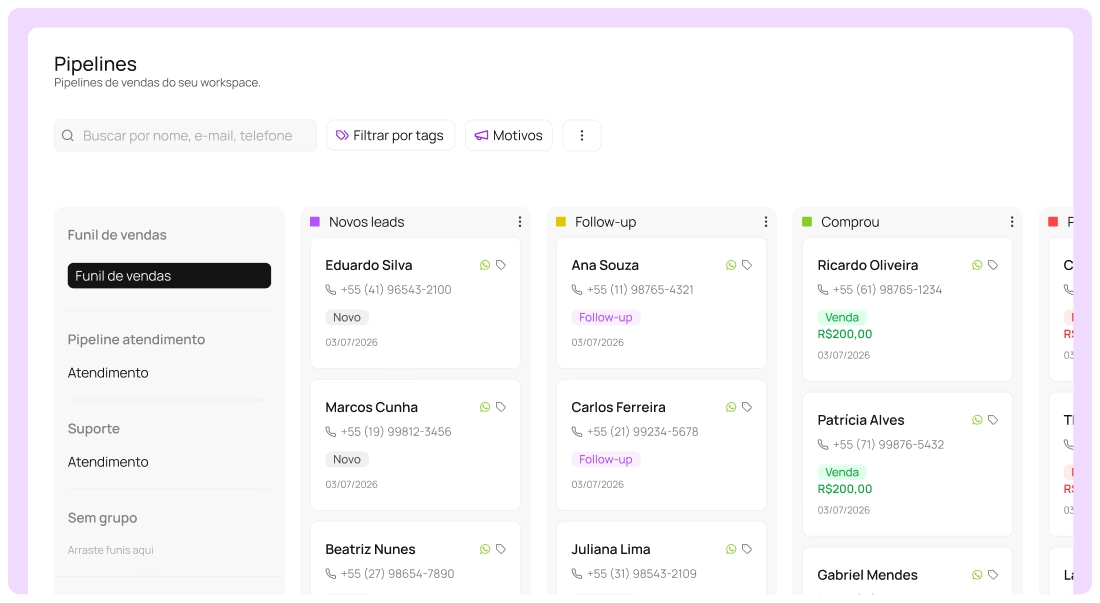
A visual pipeline: seeing instead of guessing
A Kanban-style pipeline solves something a spreadsheet doesn't handle well: an instant view of where every opportunity stands, without needing to filter column by column to understand the operation's real situation.
Instead of asking how many leads exist this month, the answer is right there on the board. How many are at first contact, how many are negotiating, how many have been stuck for days with no reply. A lead stuck at the same stage for a week is a clear signal that something needs attention right now, and that signal only exists when the operation is organized into visible stages, not hidden inside isolated conversations.
That visibility is what lets you act before the problem shows up in the month's revenue, not after, when it's already too late to recover that batch of leads.
What manual management doesn't cover: checkout, Pix and declined payments
There's a category of sale that gets lost silently, without ever showing up in any manual tracking spreadsheet. Abandoned checkout, a Pix payment generated but never paid, a declined card. These are moments where the lead has already moved close to the end of the journey, has already shown real buying intent, but something interrupted the path, whether a declined card, a forgotten Pix, or a distraction in the middle of checkout.
Manual management almost never covers this, because it requires monitoring events in real time and acting within minutes, something hard to sustain alone at scale, even with a dedicated team. This is where automation becomes part of lead management, not as a replacement for the team, but as coverage for what no person can monitor around the clock. A Pix generated at two in the morning and forgotten only turns into a recovered sale if someone, or something, reminds the lead at eight.
What to measure to optimize the operation
Lead management without metrics is just organized guesswork, even when it looks like it's working. Three indicators matter more than any other:
- Response rate to first contact. If most leads don't reply to the first message, the problem might be in the wait time, the approach, or the channel used
- Time between the lead arriving and being contacted. Every hour of delay reduces the chance of a reply. Operations that respond within minutes convert consistently differently than ones that reply the next day
- Conversion rate by pipeline stage. This is the indicator that shows where the real bottleneck is. It's not enough to know how many sold this month, you need to know which stage most leads get stuck at, whether it's the first reply, the pricing pitch, or the close, because each stage needs a different fix
Once the records are organized, the next decision is who receives each campaign. The article below covers the segmentation layer:
Tags in your WhatsApp CRM, why messaging existing customers the same way costs youHow Claryflow organizes this
Claryflow brings together CRM, a Kanban pipeline and sales recovery automation in one place, integrated with the WhatsApp Official API.
Every lead that comes in, through an ad, a checkout, or a base import, automatically enters the funnel. Abandoned checkout, unpaid Pix and declined payments get automatic follow-up at the right timing. And every stage of the operation is visible on a dashboard, with no spreadsheet needed.
Try 3 days free and organize your lead managementFAQ
Does lead management only make sense for large operations?
No. It makes sense especially for smaller operations, because every lost lead weighs proportionally more on the outcome. Organization keeps small businesses from losing sales due to a lack of process.
Is a CRM integrated with WhatsApp different from using a spreadsheet alongside WhatsApp?
Yes. With an integrated CRM, the record is automatic, the conversation and the management happen in the same place. With a spreadsheet, someone has to remember to update it manually, and that's the point where most operations fail.
Does recovery automation replace the sales team?
No. It covers what the team can't monitor in real time: checkout, Pix and declined payments. The team stays responsible for the conversation and the negotiation.