blog / Discover how companies are selli...
Discover how companies are selling more on WhatsApp
How digital creators are using WhatsApp differently
Digital creators who sell more on WhatsApp automate communication at every stage of the launch and keep active recovery flows for unpaid invoices and abandoned checkouts. That allows scale without ban risk, and recovers a meaningful share of sales that would otherwise be lost.
The difference between an average launch and one that hits its target often comes down to how much of WhatsApp's potential is being used at each stage of the process.
Here's how the top-selling creators are structuring this:
Phase 1: Warming up the list before the cart opens
The most common mistake with WhatsApp in launches is only showing up when the cart opens. By then, the lead is still cold.
Creators with the best conversion rates use WhatsApp as a warm-up channel in the days before opening. Not with a sales message, with content that prepares the lead for the decision.
A simple warm-up sequence works like this:
D-7 before the cart: a message introducing the core problem the product solves. No mention of the product yet.
D-4: educational content that goes deeper into the pain point. Could be an audio note, a short video, a direct text. The goal is to make the lead think "this is exactly what I'm going through."
D-1: preparing for the opening. "Opens tomorrow. You'll get the link here first."
By the time the cart opens, the lead has already been through three touchpoints. They already trust you. They already understand the value. The sale becomes much more natural.
Phase 2: Support while the cart is open
While the cart is open, WhatsApp works as the biggest conversion channel for leads who are on the fence. These are people who watched the CPL, read the sales page, but still have an unanswered objection before buying.
The challenge is scaling that support without losing quality, and without the salesperson working 20 hours a day.
With structured automation, it's possible to:
Automatically qualify the lead before it reaches the salesperson. The system asks the right questions, identifies the profile and awareness stage, and hands the salesperson only the conversations that need human attention.
Automatically answer common objections. "Does it work for someone starting from zero?" "Is there a guarantee?" "Can I pay in installments?" These questions come up hundreds of times during a cart window. They can be answered automatically, accurately, without taking up the team's time.
Create urgency at the right moment. With 24 hours left before the cart closes, the system automatically sends to leads who haven't bought yet. With the right reminder, a share of those leads who were putting it off make the decision.
Phase 3: Recovering unpaid invoices and abandoned checkouts
This is money left on the table, and most creators leave it behind.
In an average launch, between 30% and 50% of started checkouts are never completed. Someone clicked the buy button, started filling in their details, got interrupted by something, and never came back.
These people have already decided to buy. They don't need to be convinced again, they need a nudge to finish what they started.
A recovery message sent via WhatsApp within the first 2 hours after abandonment has a recovery rate far above any other channel. Because WhatsApp is the channel the lead will open before any email.
The recovery sequence that works:
Message 1 (within 2h of abandonment): direct and no pressure. "I saw you started securing your spot but didn't finish. Any questions? I can help."
Message 2 (24h later, if no reply): brings the offer's main benefit back into focus. Reminds them what's at stake.
Message 3 (12h before closing): real urgency. "The cart closes in a few hours. This is your last chance."
Creators who implement this sequence recover between 15% and 35% of abandoned checkouts. In a launch with meaningful volume, that can represent a very large difference in final revenue.
Phase 4: Re-engaging leads after closing
The cart closed. But the list isn't dead.
There are two groups of people that top creators actively work after a launch:
Those who haven't bought yet: leads who followed the launch, engaged with the content, but didn't convert in the cart. They might be waiting for a second cohort, might have had a financial setback, might be ready for a different offer. These are valuable leads that shouldn't be discarded.
Those who bought and could buy more: customers from the current cohort are the best candidates for an upsell, for complementary products, or for a mentorship. And WhatsApp, being a direct conversation channel, is where that offer has the best chance of landing well.
What changes when you stop using WhatsApp manually
There's a turning point that creators who've scaled describe in very similar terms: the moment WhatsApp stopped being a task and became a system.
While WhatsApp is manual, it has the ceiling of the salesperson's capacity. One person can handle a limited number of leads with quality. When volume grows, quality drops. When quality drops, conversion drops.
When WhatsApp is an automated system, the ceiling disappears. The list can grow without support getting worse. Follow-up happens even while the team is in another conversation. Invoice recovery runs even at 3am.
And more importantly: all of this happens through the WhatsApp Business official API, approved by Meta, with no ban risk.
This shift from manual task to automated system isn't exclusive to launches. The article below shows how the same principle applies to your business's ongoing marketing:
See how automation in your marketing streamlines your processHow Claryflow was built for the digital products market
Claryflow is a WhatsApp sales automation platform built on Meta's official API, which means running your operation with no block risk, at any scale.
For digital creators and launchers, Claryflow offers:
Segmented bulk sending: send the right message to the right segment of your list, at the right moment of the launch, with low ban risk.
Welcome automation to message every lead who buys your products, which helps increase trust and LTV.
Sales recovery, automatic flows that identify abandoned checkouts and unpaid invoices and trigger the recovery sequence with no manual intervention.
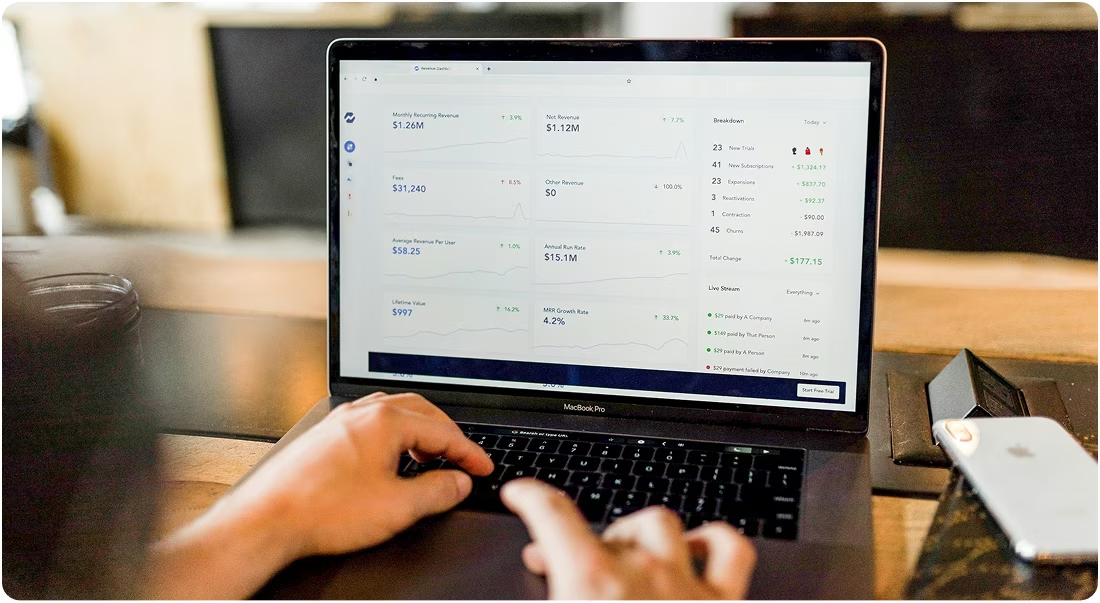
A dashboard with the core metrics to understand how your sales, revenue, profit and more are doing.
Click here to find out more